REPORTING FROM THE FLOOR OF COMIC-CON 2010
Share

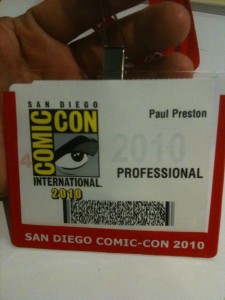
A professional what, I have no idea…

The Movie Guys go to Comic-Con

Photos and comments by Paul Preston and Justin Bowler

PAUL:
The 41st annual San Diego Comic-Con was everything the event claims to be: both nerd central and ground zero for the coolest stuff pop culture churns out every year. And, as ever, it was SUPER-packed, with lanes of people moving at Romero-zombie-esque pace and lines to every event hundreds of people deep. Should you ever go to Comic-Con, here’s some Movie Guy advice as to how to get it done right.

The San Diego Convention Center is a huge hall which operates much like a trade show during the Con, with nearly every entertainment entity you can think of present with a booth or table or something as well as retail and artist booths. Lego, Disney, Hasbro, DC, Marvel, Warner Bros., Sony, Stan Winston Studios, ABC, Fox, Dark Horse Comics and hundreds more big-time companies represent.

Give yourself at LEAST a day here, because you will not only be looking at the latest products, movies, TV shows, comics, etc. these establishments have to offer, but there’s an awesome game of one-ups-man-ship where most every booth will do giveaways, in-person celebrity appearances, contests, demos, mini-screenings, etc. Again, give yourself at LEAST one day if you want to experience everything.

In San Diego as in L.A., advertising is king.

On one end of the convention center is Hall H, the much-coveted home to the big studio presentations, mostly movies. A 6,500 seat auditorium that sees a dozen or so panels a day with A-list talent in person to help plug upcoming projects. The line to get in here is so insane, if the first panel is at 10 AM (which it was the Thursday we went), it’s recommended to get there at LEAST at 7AM and get behind the people who got in line the night before. But here’s the tip that keeps on giving. Just out of curiosity, wander to the front of the house and look for open seats. We found some in the front row!

The view for my friend Randy and myself:

The view for many others:

So even if you want to see a panel that’s at 3PM, get there at 6 or 7AM and give over the day. But fear not, there’s is never a dull moment and a cavalcade of stars. Here’s how Thursday went in Hall H at Comic-Con:

MEGAMIND (due Nov., 2010)
Easily the funniest panel of the day. Will Ferrell started things out dressed as the animated character from this upcoming DreamWorks film and milked a lot of gags out of how the blue paint burned his skin. He also brought breakfast for the crowd (a dozen donuts). Tina Fey and Jonah Hill joined him along with the film’s director Tom McGrath (co-star Brad Pitt was there in spirit, represented by a life-size cardboard standee). Hill was very funny, “coming out” as a Mel Gibson supporter and fielding questions from the crowd. The five minutes of footage looked a little familiar (this is the third superhero/supervillain movie after “The Incredibles” and “Despicable Me”), but the 3D was exceptional, as it tends to be in animation these days.

TRON: LEGACY (due Dec., 2010)
I was so anxious to PARTICIPATE in Comic-Con, I really was unprepared to CAPTURE it, so forgive these iPhone pics to which the stage lighting was a bit unkind by the time there was some zooming in. But you can make out The Dude here. Jeff Bridges headlined the panel here, and was joined by Olivia Wilde, Michael Sheen, Bruce Boxleitner, Garrett Hedlund as well as producer Sean Bailey, director Joseph Kosinski and original “Tron” director Stephen Lisberger. Patton Oswalt killed as the panel moderator here and there was new trailer unveiled, and they showed eight minutes of footage. They safely showed pretty sedate material, not so much action, but I have to say I was a little worried about the content’s feel. It seemed to by trying really hard to be sexy and hip. The original “Tron” was successful in knowing what it was and not trying so hard. Hopefully “Tron: Legacy” follows suit overall.
While Disney had the floor, they wasted no time promoting other films, too, with a surprise video from Capt. Jack Sparrow, promoting his search for the Fountain of Youth in a new “Pirates of the Caribbean” film, coming next summer.
Then Oswalt brought out Guillermo del Toro, the new force behind a “Haunted Mansion” reboot. Apparently, del Toro LOVES that stuff, goes to Disneyland every year and is hungry to do a film on this Disney property as a really scary, fun film. Hopes are high.

SALT (in theaters)
On the day before opening worldwide, the “Salt” panel didn’t bother with leaking new footage, but did trot forward the film’s star Angelina Jolie, much to the hooting of the thousands of fanboys. Also on the panel was director Philip Noyce (who gives the project a lot of cred in my book), producer Lorenzo Di Bonaventura and co-star Liev Schrieber, an actor’s actor, for sure. All the talk of stunts and 2D got me pretty excited.

BATTLE: LOS ANGELES (due March, 2011)
Aliens attack Los Angeles, so naturally a team of filmmakers went to Louisiana to shoot it…! I hadn’t heard of this film before this panel, but now I like to refer to it as “District 90210″. It has “Black Hawk Down”-esque battle sequences, except the enemy is from another world (the alien is keenly not shown in it’s entirety in an extended trailer). Jury’s out on what to expect from this film. Stars Aaron Eckhart and Michelle Rodriguez were on hand with director Jonathan Liebesman and producer Neal Moritz (“Fast & Furious”) to promote the film and start building buzz, but a March release date for a big-time actioner doesn’t show a ton of confidence. Then again, based on “Avatar” and “The Hangover”, major stars aren’t always needed for a hit. The “Battle” footage was pretty exciting and I’m hoping the whole film finds a way to be provocative AND action-packed.

RED (due Oct., 2011)
This adaptation of the Warren Ellis graphic novel brought out a star-studded panel with Helen Mirren, Karl Urban, Mary-Louise Parker and Bruce Willis (who was a bit too sleepy for me. I like my Willis more “The Late Show-appearance-y). This movie looks hilarious, if you’re willing to throw reality out and get into the comedy. Retired CIA agents are pursued for the secrets they possess, and John Malkovich looks like he might finally get to act crazy in a movie where he plays a character who’s actually supposed to be slightly crazy! Plus, everyone got a poster, which means I’ll probably buy a ticket. I can be bought like that.

A CONVERSATION WITH J.J. ABRAMS AND JOSS WHEDON
This gave pretty cool insight into the minds of two huge forces in pop culture today. If I had to pick one, I’d go with Abrams and a real top-notch cinematic scholar capable of big things. As much as I enjoy Whedon’s penchant for dialogue, I’ve never gotten on board his programs. Whedon announced officially at this panel that he is, in fact, directing “The Avengers”, Marvel’s big-deal coming-together of multiple superheroes in one movie. Am I wrong to wish it was Abrams that made that announcement? Regardless of choosing a favorite, there was hefty banter and jokes shared between these two guys. Can a collaboration be far off?

THE EXPENDABLES (due Aug. 13, 2010)
Panel moderator/douchebag Harry Knowles summed it up well when he said that if you took the cast members of “The Expendables” who WEREN’T on the panel, you’d still have a great action movie – Jet Li, Jason Statham, Mickey Rourke, Eric Roberts and Arnold Schwarzeneggar. That being said, there was a lot of comraderie and laughs to go around between those who were on the panel – Randy Couture, Steve Austin, Dolph Lundgren, Bruce Willis and Terry Crews. Their leader, Sylvester Stallone came out to huge applause and was the paison you hope he’d be. They talked about the injuries that unsurprisingly plagued the set when that much testosterone is about (and when you ask Lundgren to punch you in the chest as hard as possible) and Stallone was asked about who he DIDN’T convince to be in the film. His response: “I talked to guys like Van Damme, Steven Seagal and Chuck Norris about being in the movie. But there’s things like schedules and…insanity…that keep that from happening.” I wish I could already buy tickets.

So, enough plot, let’s get to the sights and sounds!


One of my favorite moments of the whole week – a one-hour Q&A with Penn & Teller. They even threw in a magic trick and (thank god) did something I HAVEN’T SEEN before with rings!


“The Expendables” tattoos were given out at the Lionsgate booth. I’m sure Randy wishes it were permanent…


I’m not entirely sure what this is. I think it’s guests enjoying a Wii-type dance game. But as soon as the Predator/Teddy Bear (or, “Teddator”) joined in, I had to shoot a pic.


I met actor Gary Lockwood from “2001″ and gave him a flyer and told him to watch the latest Movie Guys’ “2001″-themed July Movie Preview. You should do the same…!


Who’s this, you ask? It’s Z-Blade XX, previously mentioned in THE LATEST, here at themovieguys.net. Sometimes, to promote your indie comic book, you’ve just gotta dress like ‘em and show up!


That’s not what these guys did. They’re obviously just goofin’ on “Star Wars”. I like to call them Boba Pimp and Darth Hater.


And what’s this guy promoting? Hate? That’s right, it’s a Hitler moustache.


You’re not drunk. Well, even if you are, this TV screen is out of focus on purpose as 3D gaming was on display.


My theory? Not everyone can dress like Slave Leia. But if you can, you should.


The madness usually spills out on to the street, too, as people clamor, trample and KILL for FREE SHIT! In this case, there was a brutal body count only to be followed by massive disappointment when the free thingy turned out to be a Dragon Age II blow-up sword. As if somehow OUTSIDE the convention hall, it’s no longer cool…

JUSTIN (and his high-quality camera…) captured this:


Self Explained (Seriously, you shouldn’t need to read this).


One of the many Black Beauty cars used in the upcoming film, “The Green Hornet”.


This group of Horn-ettes is just a small percentage of the girls handing out directions to Britt Reid’s garage, where fans could take rides in the many cars from the movie.


Ryan Reynolds’ contract rider mandated he lie in this tube for the entire length of the convention.


One of these two hunts for bounty, and the other hunts for booty. The latter is at the wrong convention.


The world’s fiercest and smallest bounty hunter.


Will Ferrell and Adam McKay trying to remember what they did the night before this interview.


One real princess and two totally fake droids.


Inside the Tron bar hidden in the back of Flynn’s Arcade VIP experience. Last year’s experience revealed a first look at the light cycles. But this year, the cycles were on the floor:

So, that’s what happened, and we can barely cover 1/3 of it. But this much is for sure: Next year we’ll double the time we spend in San Diego.


THE MOVIE GUYS REWRITE: VERTIGO

Share

THE LIVING AND THE DEAD

The Movie Guys Rewrite: Vertigo

Rewrite by Steven Lewis

THIS ARTICLE OBVIOUSLY CONTAINS SPOILERS

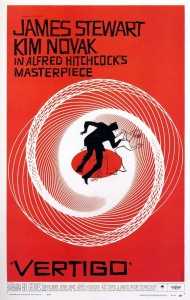
A very propitious event happened the first time I watched “Vertigo”: my DVD player broke down halfway through. Now, normally this would not be a good thing, but in this instance the technical snafu was timed to perfection: it allowed me to enjoy all of what had already transpired in this sumptuous, intoxicating movie without having to suffer the dreadful thud of the inept plotting which curtails its effects in the final stretch.

Here’s what I got to savor: Jimmy Stewart (one of my all-time favorite actors) having his vertigo first revealed to him in an opening rooftop chase, wherein his affliction prevents him from saving a plainclothes cop from falling to his death. Quitting the force out of guilt and fear, Stewart’s character – John “Scottie” Ferguson – is contacted by an old college pal, Gavin Elster, who wishes to employ his services in a private capacity. Scottie is to follow Elster’s wife, Madeline (Kim Novak – totally stunning, in the way of all Hitchcock’s women) who Elster believes to be suicidal – not through conscious intent, but because he fears her soul is being possessed or controlled by the long-dead Carlotta Valdes, herself a suicide victim.

At this point, the film becomes largely silent, as we watch Scottie follow the mysterious heroine through the sites of San Francisco: a shop, a graveyard, an art gallery, an old hotel, the Golden Gate Bridge – places that have connections with the past and/or death. Hitchcock’s mastery in laying out this sequence increases our own obsession as audience members, our desire to know what is behind the mystery.

Eventually, Scottie saves Madeline’s life when she jumps into the San Francisco Bay. He moves then from follower to protector, and comes to feel that only HE can keep her safe. The two become close, and Madeline begins – through Scottie’s prompting – to reveal more and more of her secrets. This climaxes with a passionate kiss on a cliff overlooking the Monterey Bay. And it is at this point where my DVD player broke down.

But that was OK. I felt I could practically finish the story from there, anyhow. Hitchcock had laid the groundwork so well, that it was obvious where it was heading. Clearly, Elster planned all along for Scottie to become romantically attached to Madeline. He undoubtedly dispatched a photographer to follow them around, and the shots of them kissing would be used in Elster’s divorce proceeding against her as proof of infidelity. This would allow him to get out of his marriage to a madwoman without being involved in her medical care, while still entitled to a good deal of money from her family’s fortune. Meanwhile, Scottie would have Madeline – but her sanity would still be precarious, the moreso now that her husband had abandoned her, just as Carlotta Valdes had been abandoned by her lover.

And what of Scottie’s female “friend” Midge in all this, eh? It had been revealed that she and Scottie were engaged once upon a time, back in college, and she remains a fixture in his life. We have seen her counseling Scottie after his accident, helping him track down information on Carlotta, even following him around at a discreet distance to find out what he has been up to. Certainly, Hitchcock would never introduce such a character only to have her play no role whatsoever in the third act. Naturally, then, she will contribute somehow to Madeline’s downfall.

Turns out I was wrong on all counts. Here is an excerpt of a letter written to Scottie by Judy Barton – a character we meet in the final third of the movie, also played by Kim Novak:

I was the tool and you were the victim of Gavin Elster’s plan to murder his wife. He chose me to play the part because I look like her. He dressed me up like her. It was quite safe because she lived in the country and rarely came to town. He chose you to be the witness to a suicide. The Carlotta story was part real, part invented to make you testify that Madeline wanted to kill herself. He knew of your illness, he knew you’d never get up the stairs of the tower [that is, the Church tower of the Spanish mission where Madeline supposedly jumped to her death].

Really? REALLY?! This is the plot – the ingenious murder plot? My God, how contrived! And this is how we, the audience, find out about it – in a bald-faced voiceover narration? How utterly artless, and lacking in all the mystery and dreaminess the film had been at such pains to build up. I don’t like it. I don’t like it one bit.

Firstly, conjuring such a wildly improbable story as Madeline’s “possession” by Carlotta and then investing so heavily in it, only to reveal it in the end as a tossed off murder plot ruse – well, that’s not playing fair with an audience, or our attention. It would be like finding out at the end of “The Sixth Sense” that Haley Joel Osment didn’t REALLY see dead people – he only pretended to in order to get close to Bruce Willis, and kill him. There is such a thing as going too far afield in your plot construction.

And where’s the proof that this story would even work on a character like Jimmy Stewart plays? Elster even refers to him, in their first scene together, as “the hard-headed Scott” – in other words: a grounded man, a natural cynic, someone not prone to wild flights of romantic fantasy. In short, not someone likely to fall for this “possession by a dead woman” claptrap. Had the Scottie character been established as an idealist, a romantic, perhaps someone who’d even had a lover die on him in his past – or just someone who himself was only barely on the verge of sanity – he would make more sense as a mark. But not this guy.

Hitchcock has famously said (and others have said for him) that this is his film about romantic obsession, and how deadly it can be. In the final third we watch Scottie’s pursuit of Judy Barton, and his endeavors to “re-make” her into the image of his beloved Madeline. But how can we really view this as romantic madness when we, as an audience, know that Judy and Madeline are indeed the same person? Is Scottie truly mad, in the grip of deadly passion – or are his instincts as a detective just so finely honed that he sniffs out the truth regardless?

Wouldn’t it be more effective – more “maddening” – if there were no murder plot at all, that Madeline dies in just the way she appears to, and that Judy Barton really and truly is a separate individual? How chilling would it then be to watch Scottie impose Madeline’s look, dress and character upon the unsuspecting Judy, in order to bring the dead back to life. And then, for him to take her – unbidden and unprovoked – to that Spanish mission, and induce her to run up the flight of stairs to the top and bid her jump, in order that he might put right his initial failing, and “save” her this time? And then . . . and then to have her do it, and him to pull back in the end from saving her – and us not knowing whether it was because his vertigo got the better of him again, or because in some deep place in his psyche he wanted to either “kill” this impostor, this pretender to the throne of Madeline . . . or even to do away with this entire romantic attachment. In any case, watching this once decent man stand at the top of a church tower, looking down upon the lifeless figure of a woman he had deliberately driven to her death – with, perhaps, the nun coming up behind him to intone “Poor girl. But there was nothing you could have done.” Wouldn’t that ending be ten times more chilling than the one Hitchcock devised, and all in a way that plays totally fair with the audience?

It would in my world, anyway. Someone tell me how I can set my DVD player so that I get THAT result next time I put this movie in.

“Vertigo” is available on DVD.


PREDATORS

Share

THE PLURAL OF CRAP

Predators

1/2*

Review by Justin Bowler

Easily the worst “Predator” movie of the franchise (And THAT is saying something)!

SPOILER ALERT! THIS MOVIE IS TERRIBLE AND I GIVE SPECIFIC EXAMPLES. (With that said, I still recommend you read the review and save yourself 1.5 hours of your life.)

Some movies I can accept as bad and move on without being exceptionally harsh. However, when Hollywood reboots/re-imagines/capitalizes-on property that already exists, naturally it merits a comparison to the original. So, I feel completely justified in examining every excremental ingredient that went into creating this boiling hot pot of fecal stew.

It seems to me that a filmmaker really has to go out of his way to make a film this bad. It is one of the worst films I have seen in a long, long, LONG, L-O-N-G TIME! It isn’t just bad. It is the trifecta of bad. It has terrible over-acting, excruciatingly awful writing, and beyond unbearable direction. I almost feel as if the whole world isn’t in on the massive joke that Robert Rodriguez and Nimrod Antal are playing on us. Let us take a look at each leg of this fantastically awful film.

The acting…

While I personally think Adrien Brody is an exceptional actor who not only earned his Oscar, but also had an extremely emotional and awesome acceptance speech, his talents were lost in this film. Clearly, he was directed to play this character as “tough”. And as everyone knows, all tough characters speak in raspy and gravelly voices. Unfortunately, Adrian’s was better suited for a sex hotline, than an action hero. With many laugh out loud moments, he delivers a particularly good comedic performance.

The Writing…

I have a 7-year old nephew, Jeffrey, and I have heard the dialogue he uses when he is playing with his Batman action figures. Now, I can’t personally verify that he was hired to write the dialogue for this film, but I have a pretty good idea that he did. Oh, I’m not saying he came up with the storyline. That would be absurd, he’s only 7. However, with the low level of dialogue in this film, one wonders if the writer was either a child (who has only seen low budget crappy action films from Bulgaria), or if the writer speaks English as a second language AND his only writing credits actually include… low budget crappy action films from Bulgaria (You make the call… the writers don’t have many credits on IMDB). (But, my sister has been calling my nephew “Alex” a lot lately.) (Hmmm.)

The Direction…

Shouldn’t the director see the plot holes if the writer doesn’t? Early in the film, one of the characters, who was aware of the 1987 “Predator” event, conveys that the only survivor covered himself in mud so he would not be seen by the Predator. Well, the experienced warrior, or the smart warrior, or even the slightly better than retarded warrior, would immediately cover himself with mud. Instead, our “heroes” completely disregard this info altogether (thus making the entire conversation pointless). (BTW, a good writer would have cut the pointless dialogue.) (But, really, I can’t expect my 7-year old nephew to think of everything, so I blame the director.) Next, the “heroes” come across a Predator’s gun, cloaking helmet, and body armor. After seeing it demonstrated on a human (so they can see that THEY CAN USE it), they disregard it, instead they, apparently, load up on some random FLARES. (Understand, these weren’t super flares. They weren’t magic flares. They weren’t even good flares. They were just flares. (You know the kind… the ones that light up the area, alert the Predator to your position, and then go out 15 seconds later.)) Finally (and the most absurd), in the finale, our “hero” has the drop on the Predator… I will set the scene. First, Adrien Brody takes off his shirt. (There is no reason for this, other than we needed to see he is more than just a guy with a tough voice.) Second, he lights everything on fire. This is so the evil Predator won’t be able to see anything with his heat sensitive vision (Remotely clever, I’ll admit). Then, it gets a little unclear… I’m not sure if the Predator forgets how to take off his helmet so he can look at things with regular eyes… or if the Predator just is too intimidated to look on Adrian Brody with his shirt off, but FOR SOME REASON the Predator keeps his helmet on, remaining “blind” so Adrien can go after him with a hatchet. (Yes, that’s right, I said hatchet.) “Why not a gun?” you ask. EXCELLENT QUESTION!!!!!!! It wasn’t because he didn’t have one, because he did, less than THIRTY SECONDS BEFORE. Yet, he uses a hatchet, and the Predator gets the drop on him. Then, it is up to someone else to pick up the gun Adrien should have used in the first place. The entire sequence is stupid, contrived and amateur. But, at the same time, that is so representative of the entire film. And these are just highlights. I have not even mentioned the overused camera shots to “show suspense” and the absurd and unnecessary twists in the story.

I am very surprised that Robert Rodriguez had his fingers in this fresh, hot baked pie of crap.

Skip it. (And tell your friends to skip it.) (In fact, tell strangers on the street to skip it while you are at it.) I give it half of a star.

Directed by: Nimrod Antal
Release Date: July 9, 2010
Run Time: 107 Minutes
Country: USA
Rated: R
Distributor: Twentieth Century Fox

OFFICIAL TRAILER


INCEPTION

Share

NOTHING HAPPENS UNLESS FIRST WE DREAM

Inception

*** (barely)

Review by Joel Frost

For the first forty-five minutes or so of “Inception”, Christopher Nolan’s latest brash endeavor, one has the sense that things are teetering on an edge. It’s a familiar precipice, not unlike the expectant fitfullness one can feel before sleep. That period of time can seem interminable, no matter how long it lasts. There’s an expectancy, a hope for the pleasant haze that often follows. There’s no certainty, however. A rough jolt into harsh reality may be all that’s in store. The exposition of sleep, let’s call it. If one focuses, one can start to see and feel the end of it. Ideally of course, there’s little need for this phase to be protracted. Sleep, movies, and reviews… all best if they don’t muddle too much in the in-between portion of matters. Best to get to the point.

Fortunately, “Inception” does eventually get to the point. This is a tale of two films, really. The first section is a long preamble, filled with stilted exposition and loose detail (broken up by one magnificent on-foot chase sequence) that has an inherent immaturity. Nolan is so in love with his idea for this film that, for a while, it comes off as an eager and panting adolescent who’s dying to tell you the good part of what he’s just come running from, yet knows it won’t seem nearly as interesting without the fairly mundane set-up. The best writers and directors can usher an audience through this section without it feeling stilted and rote. Nolan hasn’t perfected this aspect of his artistry.

Ever so slowly, though, the film rounds into form. Leonardo DiCaprio plays Cobb, a dream infiltrator. He is a master of stealing thoughts and ideas from the sleeping minds of those who have thoughts and ideas that make money. Cobb, with the help of a B-Team of assistants, find themselves inside the slumbering head of the enunciation-challenged Saito (Ken Watanabe). He dodges their best efforts and then, when they all wake up, asks to hire them for a mission of great importance to him and his bank account.

Money isn’t the only motivator here, though. We learn that Cobb is a fugitive from his homeland (the USA), a situation that arose from some kerfuffle with his now-dead wife Mal (Marion Cotillard, a bright light we long to go toward). His children are still in the US and he’s dying to return. Saito has the power, with one phone call, to clear the path for Cobb. It’s not an easy thing that Saito is asking of Cobb and his cronies, though. Inception (from the title), or the planting of an idea, rather than extracting one, is what Saito needs. He’d like a rival to come upon an unlikely decision, and he knows that if anyone can insinuate the idea into the head of the rival (Cillian Murphy), it’s Cobb.

What is slowly revealed in “Inception” is that the dream world that is shown is fairly similar to the “real” world that Cobb exists in. As Mal points out to him during a dream sequence, the way in which he is pursued by anonymous agents (apparently to hasten his extradition to the US) in the “real” world is almost indistinguishable from the way various inhabitants (increasingly violent representations of the dreamer’s subconscious, it is explained) pursue him and his cronies in dreamyland. The question then arises: Is Cobb a denizen of the real world who occasionally visits dream worlds, or is his reality perhaps a dream in itself. Mal complicates Cobb’s perception of this by tearfully asking him to come join her and the children by waking himself up… by shooting himself. Counter-intuitive, of course… but perhaps the right choice.

Ellen Page is along for the ride as the architect of most of the depicted dreams and contributes as either bland or understated, depending if a viewer is alert or half-awake while she drones her lines. Joseph Gordon-Levitt, fresh from the worst movie ever made in the history of mankind, “(500) days Of Summer”, manages to serve his duties decently (let’s hope he remains a perennial side-kick). Michael Caine shows up and delivers a few lines. In particular, he asks Cobb to “come back to reality”. Whose reality, though, is reality?

It’s this device that lies at the heart of “Inception”. It’s also the stumbling block of many stories, whether depicted in film, literature, oral tradition, etc., for ages: usage of the deus ex machina that “nothing is real”. It can often be the thinnest of ruses, the sign that a piece is flawed and shallow. For if no reality matters except the one that the writer chooses at a particular moment, then a writer (and consequently an audience) is often utterly adrift in directionless nonsense, disguised as complexity (see: “The Matrix”).

“Inception” manages to narrowly avoid this central pitfall. Nolan finds his stride after an early clumsy lull. The sense that Cobb, Mal, et al are in-between realities is not abused or manipulated as a license for carte blanche. Nolan reels the audience in with a thin tether, and the effect of not knowing with absolute certainty whose reality is the absolute truth does not feel empty.

Cobb carries, as each of the dream inhabitants do, a personal token… in his case a small top that he spins. It will eventually succumb to the physics of the world around it; in the “real” world, gravity soon ends its activity. “Inception” calls into question the very physics that we take for granted, though, with many fine MC Escher-esque panoramas and situations. When one is constantly immersed in these various worlds and indeed can construct them and inhabit them happily, while also manipulating the minds of others and one’s own, how can one rely on the spinning of a small top as the absolute proof of what is real? Nolan sets this up as the core question, and it pays off in a teetering yet somehow rewarding ending. There. Now I have planted the idea in your head to see this movie. That wasn’t so hard.

Directed by: Christopher Nolan
Release Date: July 16, 2010
Run Time: 148 Minutes
Country: USA
Rated: PG-13
Distributor: Warner Bros. Pictures

OFFICIAL TRAILER


RANTING ON A CLASSIC: ONE FROM THE HEART

Share

OR, RE-EXAMINING A FAILURE

One From the Heart

Rant by Steven Lewis

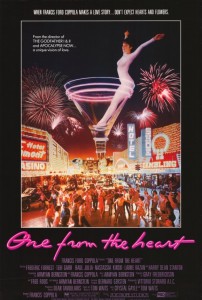
With truly great directors, it can often be just as rewarding to examine their infamous misfires as their greatest successes. Well, you couldn’t ask for a greater director than late ’70s Francis Ford Coppola – and there exists no misfire in ANY director’s career as big as “One From the Heart” was for him back in 1982. For those who don’t know or can’t remember, this is the film he made after “Apocalypse Now” and it basically bankrupted him: it went wildly over budget and it was universally panned – I mean everyone really really hated it. It got distribution for, like, a month in only about nine cities and then faded away ignominiously. So much of his own money was involved that he essentially had to whore himself as a hack-for-hire director for the next fifteen years just to become financially solvent again, allowing any personal projects or ambitions he had to whither on the vine. In short, it is the film that ruined him.

Now, with all that bad mojo as part of its rep, you may ask what the problem is with “One From the Heart”. I’d certainly been curious enough over the years to finally check it out some time back, and I can say this right off the bat: whatever else the film may be, it is unquestionably a finely crafted movie made by a director at the height (or near enough the height) of his powers. The problem, such as it exists, is that his skill and attentions are channeled exclusively at the visual elements of the film. (Perhaps I should actually say technical aspects, because there is also a running-commentary-type songtrack composed by Tom Waits, and sung by Waits and Crystal Gale, which is brilliantly faded in and out to counterpoint and comment on the action of the story.) Lighting, transitons, editing, scrim work, gorgeous set design – the film is quite a sumptuous visual feast, and the artistry is so upfront and on display that you can’t help but be tickled by it – essentially, by the director’s ingenuity and tour-de-force style. However, the central story of the movie – basically, a prolonged lovers’ spat – is so hoary and cliche-ridden you wonder why anyone would bother building a film around it. I mean, everything about the actual STORY itself – dialogue, acting, character motivations, in fact the entire central premise – is so laughably weak that any moon-eyed junior high hack romantic could come up with something better. And yet. . .

And yet, I’m reluctant to call all this a mistake on Coppola’s part – at least in the sense that he didn’t know what he was doing (whether you agree with his artistic choice is entirely another matter; clearly, no one did). Free from a story that’s compelling, the audience can better give itself over to and be enveloped in the kind of lush atmospherics that the director is interested in crafting – the kind that would be annoying and out of place if our primary goal was to find out “What’s going to happen? Where’s this story going to go?” It’s a tone poem, essentially – a visual and auditory tone poem, and to criticize it by saying it presents a weak story is to fail to encounter the film on the level it means to engage you. Just as to criticize “2001″ for having so little dialogue and an ending that makes no literal sense.

This is not to suggest that “One From the Heart” is anywhere near the achievement of “2001″ (far from it!). Nor am I claiming that the film is a complete success even on its chosen level (it isn’t – which I’ll get to in a minute). What I’m saying is I can see why it bombed – and bombed big time – because with movies, people generally take in with them (consciously or not) the notion that the telling of a strong or compelling story is the film’s ultimate reason for being. What Coppola was challenging here (and what Kubrick challenged in “2001″, far more purposefully and successfully) was the idea that story was anywhere near as important as the visual and the sensory in the crafting of a film. Thinking that way comes from a novelistic, literary approach which does not necessarily best conform to the notion of what film is all about. That is: theoretically, anyway, film could begin and end with visuals (“Un Chien Andalou”, anyone? “Fantasia”?). Film CANNOT begin and end with story and dialogue: these exist to complement the visual and to aid in the trajectory of the film – but they can be jettisoned if a director feels they get in the way of the mood he wants to evoke or the sensory experience he wants to impart to his audience.

Let’s put it this way: Coppola used an archetypal story here. Basically, it is this: boy and girl fight; boy and girl break up; boy and girl take up with other lovers for a night; boy and girl realize that they love each other and get back together (all under the bright and gaudy lights of Las Vegas on a festive Fourth of July). It’s not so much that it’s a bad story, just such a basic one that the viewer is clued in to the fact that it is not where his or her attention should be directed. Much like, I guess, opera plots: I personally don’t care much for opera, but I at least know that the people who do are not drawn to it for the profundity of the stories. These are basic, melodramatic, and corny. But without that thru-line to hang the music and pageantry onto, it’s not an opera – it’s just a recital.

What gets tricky in describing it, I guess, is that Coppola did not do it particularly well. At least, he didn’t follow it through completely enough. If the whole picture had been structured more like a silent film, where the characters didn’t talk – but where the Tom Waits songtrack incessantly played and commented upon their emotions – it would have found, I think, the right pitch. As it is, the sequences that are shot like this work wonderfully. It’s only when the characters speak, and Coppola tries to introduce at least a suggestion of realism, that the thing fails because the rest of it has the logic of a dream (or at least an extended production number) and the contrived dialogue falls clunkily flat. Still, I found it to be an interesting (if failed) experiment because it’s one I’d never seen tried in quite this way (at least in the medium of film) and parts of it do achieve a purity and beauty of form. I feel I can see its influence on such subsequent film musical experiments as Baz Luhrman’s “Moulin Rouge” and Rob Marshall’s “Chicago” adaptation. Anyone who enjoyed either or both of those films would, I think, get something positive out of a viewing of “One From the Heart.”

As for Coppola himself: had I seen this film when it first came out – particularly on the heels of “Apocalypse Now” – I would have been stunned, dumbfounded, and absolutely certain that he had lost his mind and given away his right to be called an Important Artist (which is basically what happened to him – in both critical and audience circles). However, I still would have been blown away by the sheer artistic technique and the talent he displayed in getting this vision on screen. To paraphrase Quentin Tarantino’s remark about Brian DePalma and “Bonfire of the Vanities” – I would have said (in 1982) that “One From the Heart” is the kind of bad film that only a truly great director could make. Going on thirty years later, I don’t think I’d call it “bad” anymore – but it certainly does itself no favors in directing an audience to its virtues; you have to work at this film a little bit and make some allowances in order to get enjoyment out of it. It stands as an unquestioned “technical achievement” – and we all know how cold those can be, albeit fun and interesting if we’re in the right mood – but with the possibility that it could have been more had it been more rigorously conceived. That is – more (not less) stylized and rarified, hence truer to its own intentions, without the embarrassing and half-hearted attempts at “realistic” character portrayal, which only underscore how wildly fake and unbelievable everything else is.

But you know what? Fakeness and unbelievability, when achieved with this degree of skill, and with this much care, love and finesse – I’ll take ‘em!

“One From the Heart” is available on DVD.


KNIGHT AND DAY

Share

GIBSON AND HAWN AT THEIR ADORABLE BEST

Knight and Day

***

Review by Paul Preston

Oh, man, what a great trip to the ‘80s “Knight and Day” is! Remember when Richard Dreyfuss and Emilio Estevez could crack jokes and dodge bullets, or when Eddie Murphy would make us laugh, then kill a dude. That feeling is alive and well in “Knight and Day”, the new action comedy from unlikely director James Mangold (“Walk the Line”).

Based on the trailers, this movie looked like it was going to try REALLY hard to make you (and by you, I mean everyone) like Tom Cruise again. After a nasty spate of PR, this looked like the “I’m sorry I was a nut. Remember how much you like me as a movie star?”-project that he hoped would launch him back to the top of the box office, where now reside the likes of Johnny Depp, Sandra Bullock and Robert Downey, Jr.

The thing about Cruise’s performance is that it DOES work. He’s perfect in this part, as long as you’re willing to go along with the movie’s conceit that despite the presence of bad guys, twists and turns and death everywhere, there really isn’t a presence of danger. There’s just enough peril to bring our leads together and create some truly impressive action sequences.

The plot is about rogue secret agent (Cruise), positive that those he used to work for are now out to get him. He’s come across a limitless power source (a SUPER-battery), who’s creator (Paul Dano) must be kept safe. But how rogue is Cruise? In it for himself perhaps? These questions dog June Havens (Diaz), who stumbles into his company and gets stuck there for her own safety, for the thrill of it all, and because she’s the number two billing on the feature.

The ‘80s have actually been pretty good to movies this summer. “The Karate Kid” is a certified hit, and although “The A-Team” didn’t fare as well, there are two action sequences in that film that are unlike anything I’ve ever seen (they involve a tank and the huge finale at the Port of L.A.). If “Knight and Day” is really an ‘80s action movie at heart, it, too, delivers the goods big time when it comes to action. Not by providing completely unique setups, but by doing the common EXTREMELY well. This is probably because Mangold is at the helm, the director of the very strong western “3:10 to Yuma”. A lesser director would probably spend half the time trying to impress with whiz-bang overuse of style. For example, Mangold takes the car/motorcycle chase and presents it without excessive shaky-cam and A.D.D. cutting to where the stunts and choreography are remarkable. Not to mention the film globe-trots like a Bond movie, moving from one exotic location to another, and Mangold’s shrewd camera captures each place in all its splendor.

Cruise and Diaz have an interesting relationship, too. It’s almost non-romantic, even though shades of that are shoved in there once in a while. Cruise’s character, Roy Miller (strangely the same name of Matt Damon’s character in “Green Zone”), is SO good at what he does, the ease with which he dispatches action puts him more in the role of her protector than her lover. Diaz does the Goldie Hawn thing pretty well, doing the usual “I don’t know how to use this gun” bit. But thankfully, she didn’t scream too much to where Indiana Jones had to get an elephant to splash water on her. She wasn’t totally helpless, which is WAY too ‘80s a female character trait to work in 2010.

It usually the humor of a film like this that can sink it. But “Knight and Day” thankfully bypasses trying to be hip and instead gets a lot of laughs out of character and situation. Especially good are a couple of hilarious montages where one character is in and out of consciousness, but is apparently traveling a great distance, despite their hazy ability to gauge it. Also, there’s a great bit with an auto transport vehicle that sends up a long-standing movie gaffe.

It’s a shame Tom Cruise went crazy, ‘cause I think this film could’ve been another in a long list of easy-to-enjoy summer actioners, but it’s considered a flop, taking a backseat at the box office to “Grown Ups”, the obligatory annual Adam Sandler offering. Now Mel Gibson has proven that he, too, is a crackpot. Their demise can lead to a ton ‘o’ laughs, but deep down it’s saddening. These are two of the strongest leading men in the movies in the last twenty years.

I don’t know what criteria is required to have a comeback work. It seems like “Knight and Day” would be all you have to do. Mel is probably finished, jury’s out on Christian Bale, but his “Terminator Salvation” and “Public Enemies” last year did good business. Russell Crowe seems to have rebounded from his anger issues and led “Robin Hood” to the biggest moneymaker team-up with Ridley Scott since “Gladiator”.

Matt Damon is probably the closest thing we have to Cruise in his prime. Maybe DiCaprio matches Gibson’s intensity, but DiCaprio chooses more flawed characters. But when I look at who’s next to replace Cruise and Gibson, I’m reminded that I don’t want to do that yet.

Directed by: James Mangold
Release Date: June 23, 2010
Run Time: 109 Minutes
Country: USA
Rated: PG-13
Distributor: New Regency Pictures

OFFICIAL TRAILER


JONAH HEX

Share

FROM THE FILM SCHOOL OF CONTRACTUAL OBLIGATION

Jonah Hex

*

Review by Paul Preston

If you see “Jonah Hex”, I dare you to remember it. This summertime graphic novel adaptation is full of stuff the filmmakers think you want to see with no care given to actually reasoning out why said stuff should be paraded in front of viewers.

Josh Brolin plays a bounty hunter and former Civil War soldier who is called upon to track down Quentin Turnbull, an 1800s terrorist who has gotten his hands on a weapon of mass destruction. Turnbull is the same man who, in a fit of revenge for the death of his own son, killed Hex’s family and horribly disfigured his face. There is also a level of the supernatural here that gives Hex the power to talk to and raise the dead. Oh, and he has a huge machine gun.

The shoddy filmmaking on display here dooms “Jonah Hex” from the start. Director Jimmy Hayward wants to have fun with the anachronisms of a sci-fi-laced, mystical old west, but instead of living in it and kick-starting a genre, he gets caught up in hack action scenes.

The actors might have been able to save this, and much has been made of Josh Brolin being the shining light in this sinking ship, but even his grumble gets tiresome fast. Which is to say he’s good, but the concept of a dude with his mouth half-shut growling through a feature-length movie isn’t appealing. It’s like mumblecore in the old west. Brolin has appeared in so many prestige projects lately (“No Country for Old Men”, “Milk”, “W”), that I guess he wanted to do something in search of mass appeal. Please stop. You’re SO good in everything else, avoid the summer movies at all costs or fear becoming Billy Bob Thornton, who can no longer cross back into anything of substance.

John Malkovich further nails the coffin shut on his serious acting career. It’s SO SAD to see that this guy hasn’t ATTEMPTED to give a performance that means anything in years. Nowadays, he just takes parts where he can be over-the-top and perpetuate his “I’m a loon” late career goals.

Will Arnett is hilarious, but “Jonah Hex” is proof that he won’t become a crossover comic any time soon. Megan Fox is a non-presence, showing up to make you swoon and then actually looking offended that you don’t. Wes Bentley is determined to make you forget that you first saw him in “American Beauty” and thought at the time he had promise, and the worst offense is that the great actor Michael Fassbender even appeared in the project, after such a top-notch performance in “Inglourious Basterds”. Stick to the fringe, Michael.

Most of the ‘score’ was by the rock group Mastodon, to desperately remind you “HEY! We’re not a stodgy old western, we’re hip! Please like us!”. VERY quickly, their pounding rock pummels your head to the point of needing Tylenol. There is some orchestral presence by Marco Beltrami, but most of the time, Hayward wants to make up for the lack or real action by backing whatever’s happening with unrelenting rock. It doesn’t work.

And take this for what it’s worth. Listed among the thirteen producers for this film is “Friends”’ Matt LeBlanc.

Opening “Jonah Hex” opposite “Toy Story 3” could be considered counterprogramming, but it also could be read as “we have no faith in this”. That attitude is also seen in the production quality. The special effects don’t meet Warner Brothers-summer-blockbuster standards. That money must’ve gone to “Inception”, which I know the studio has HUGE hopes for. I’m shocked “Hex” didn’t get dumped in late, late August, if not the fall.

“Jonah Hex” has a running time of 81 minutes, another sign that the filmmakers really didn’t have a lot to present us here. And stop me if I’m overreacting or using too-strong words, but I was offended by how short this movie was. Ninety minutes is usually the minimum for a comedy or animated film, with most other stories running longer. These credits run so long, the actual time the movie is being told is not much more than an hour. They should pay US for them doing so little work.

Directed by: Jimmy Hayward
Release Date: June 18, 2010
Run Time: 81 Minutes
Country: USA
Rated: PG-13
Distributor: Warner Bros. Pictures

OFFICIAL TRAILER


CYRUS

Share

NOTHING TO DO WITH HANNAH MONTANA

Cyrus

**1/2

Review by Mark Tucci

If you’ve seen the trailer, the film Cyrus looks like another comedy ripe with antics such as those in other films starring the two lead actors. That it ends up being something completely different works both to its favor and its detriment.

Borrowing a simple and somewhat familiar plot, the movie sets itself up as a standard relationship triangle between long-time single guy, John (John C. Reilly), single-mother, Molly (Marisa Tomei), and Cyrus (Jonah Hill) – the major difference being that Cyrus is Molly’s son, and he’s 21 rather than 10. While this sounds like the makings of an over-the-top, vindictive, slapstick comedy of embarrassment, what we get is much more subtle and subdued.

Directors Jay and Mark Duplass (Baghead, The Puffy Chair) continue to expand on their mumblecore movement roots – mumblecore being loosely rehearsed, roughly sketched scenes and improvisational dialog. That it succeeds at all in this film is largely thanks to John C. Reilly and Jonah Hill’s skilled performances and on-screen chemistry.

However, Cyrus is a film that doesn’t seem to know quite what it wants to be. I know what the marketing people want you to think it is: 2010’s Step Brothers. Indeed, many of the people in the theatre were expecting exactly that, and I heard plenty of grumbling afterwards about its failure to deliver on what the trailer seemed to promise. Once again, the trailer showcased 90% of the film’s funnier moments. Keep this in mind before checking it out below.

Make no mistake: Cyrus, though billed as a comedy, is really more of a dramatic exercise in passive-aggressive behavior and restraint. That this happens to present comedic situations and exchanges feels more like a bonus rather than part of the plan, thanks again to the talents of Reilly and Hill. There are plenty of moments in this movie where you think you know what’s going to happen. You think you know, because you’ve seen similar scenes in other comedies where it does happen. The often surprising thing with Cyrus is that it doesn’t happen here.

I applaud the directors and actors for choosing the road less travelled and not devolving into cliche, the only problem is that what we get instead isn’t necessarily the better option. It’s precisely because of this that the movie tends to feel a little lost – trying often to let nuance, drama, and good acting carry the scene rather than the expected easy gag. Sometimes this works quite well, other times it doesn’t. Such is the gamble with the mumblecore movement.

Another place the film tended to break down was in the pacing. 92 minutes felt more like two hours and the awkward, uncomfortable situations seemed to linger on screen just a little too long. However intentional this might have been, it didn’t seem to work for me. Oh, and can we officially call an end to the whole constantly-moving-and-zooming camera style? It didn’t work as intended here and often drew too much attention to itself.

Beyond the technical aspects though, there is much good to be said about the film’s two leads. Reilly and Hill’s combative relationship on screen plays out nicely, and they really do a good job of bringing their characters to life. Reilly deftly wrestles with the conflicts of his relationship with Tomei, as well as with the antagonistic, unnerving behavior brought on by Hill. Hill is in a whole new element here and he takes to the challenge quite nicely. This is a role unlike anything we’ve seen him in before and his performance constantly keeps the audience guessing as to whether he’s as messed up as he seems.

Reilly and Hill comprise just about everything that is good in this film. Marisa Tomei, while having her moments, is just not as believable as her two male co-stars, and the rest of the cast seem to exist entirely so John can bounce his frustrations off someone.

As a case study for improv acting and the appreciable talents of people like Reilly and Hill who can pull it off, Cyrus succeeds and has merit in viewing. There are moments of real brilliance, real emotion and real comedy – they just don’t all add up to a real movie.

Directed by: Jay and Mark Duplass
Release Date: June 18, 2010
Run Time: 92 Minutes
Country: USA
Rated: R
Distributor: Scott Free Productions

OFFICIAL TRAILER


OVERLOOKED GEMS, PART 3: BAD MOVIE NIGHT

Share

Reviews by Steven Lewis

There are some movies that are not merely “overlooked” but have actually been BRANDED: popular and/or critical opinion has placed a scarlet “B” over their video box, and viewers are appropriately wary of even giving them a try. Below are three movies that, in my estimation, deserve rescue from the cinematic scrap heap that they’ve been consigned to. Classics? Perhaps not. But considerably better than their rep, and worth at least a look-see by the discriminating cinephile.

THE GODFATHER: PART III

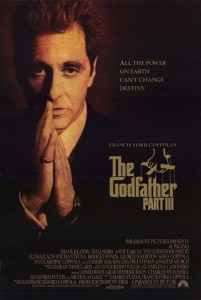
This thing has become something of a whipping boy for sequels (particularly threequels) over the years, and I just don’t feel it’s warranted. OK, biases right up front: the first Godfather is my favorite film of all time, while the second one I find generally opaque, hard to follow, and largely unnecessary. Within that context, Part III is not any more “necessary” (“The Godfather” being a film of such stand-alone power that it requires no sequel), but if it was a saga the studio was determined to make, then I find this film a much more worthy wrap-up to the series than the second one ever was. It teems with all the elements that make the Godfather saga so engrossing: strong characters, shadowy back-room negotiations, elaborate plotting and double-crossing, shocking yet fantastically orchestrated violence and, finally and most memorably, an operatic finale which is a masterpiece of cross-cutting between organized ritual (in this case, an opera) and acts of murder. If the film sags around the edges, well – that’s entirely appropriate too, since Michael Corleone, its lead character, is himself now aging and frail. It is as if each of the Godfather films takes its cue from Michael’s metabolism: the first is full of zest and youthful exuberance, the second is cold, hard and steely, and the third is creaky and totters on the brink of collapse. Many take this as a fault of the film, when really it is the perfect mirror of the soul of Michael himself. As such, the weariness which pervades the entire story is poignant and heartbreaking, not the result of bad filmmaking.

The acting is all first rate, as is expected by now in a Godfather film. As Sonny Corleone’s bastard son Vincent Mancini, Andy Garcia makes a strong impression and the push-pull between he and Pacino – the young hothead vs. the wisened and calculating veteran – gives the film its edge, and its unique place in the Godfather canon. It is slightly unbelievable that Michael would have no one else to turn over the running of the family to besides Vincent, a tangential relation at best, but since it works dramatically you tend to overlook the flaw in logic. Likewise, the scenes between Michael and Kay carry a special charge; though written near the level of soap opera, the fact that it is actually Pacino and Diane Keaton sitting across from each other, and that we have shared so deeply in their history together, breathes a curious kind of nobility and sadness into them. Like everyone else, I missed Robert Duvall as Tom Hagen, but even his absence serves, in an ironic way, to underline the theme of Michael drifting toward the end of his life, losing all his associations along the way; the loneliness and solitariness which enveloped him by the end of the second movie have not gone away, and his attempts to fight against and deny this fact is what gives his character real tragic dimension here.

OK, just a word on Sofia Coppola as Michael’s daughter Mary. No, she’s obviously not a trained actress and her readings are a little flat, but you know what? It doesn’t make that much difference. Her character exists more as a symbol to Michael of innocence and incorruptibility than as a true three-dimensional personage. As such, she at least has the right look and feel – I can imagine her as Pacino’s daughter in a way I don’t think I ever could have bought Winona Ryder (who was originally to play this role). What I’m saying here is that, while she’s not great, she does what she needs to do and she in no way sinks the film – if for no other reason than that her screen time isn’t large enough to do so.

All in all, this is a first-rate film, with a plot line that is at times admittedly hard to follow, but not nearly as much as the one in Part II. And this one has a better cast of characters: just think of it, the Corleones getting into business dealings with the Vatican! The audacity of this storyline alone should make it beloved to all true Godfather fans. And some of the violence here – including the helicopter assault in Atlantic City, the murder of Joey Zasa on the streets of Little Italy, and, most notably, the new and wildly unexpected use found for a pair of reading glasses – is as brilliant and memorable as anything in the first film, and supersede the second one entirely. In short, “The Godfather, Part III” makes a great wrap up to the entire saga, and earns its full place in the family history; it’s no mere footnote, but a great and satisfying film all its own.

REALITY BITES

When I first saw this movie, at the time of its initial release, I really liked it a lot. I didn’t necessarily buy it as the “definitive Gen-X movie” or anything, but it still offered up a feast of pleasures: Wynona Ryder (who I don’t normally like) at her sexiest and most appealing, a quirky and irreverent script, a GREAT soundtrack, and the projection of a real “lived-in” feel amongst the main group of friends. Their hanging-out and their conversations with each other felt very genuine and unforced, and reminded me of times I’d spent with my own friends. People who criticized the film – and there were many – for “just showing young people sitting around” forget not only how much of life (even the enjoyable parts) is spent doing nothing particularly momentous, but equally how difficult it is to capture that elusive, just-sitting-around quality on film. Heck, I even thought Ethan Hawke was terrific (although this was due more to my inability to get over the fact that it was the same actor who played the nervous, uptight kid in “Dead Poet’s Society”).

Looking at it today, though. . . . well, I still like it, but I can see more clearly a lot of its flaws and why many people (particularly those of my age group, i.e. the Gen-Xers) didn’t like it. It is a bit too self-important, and many of its moments feel forced. The romantic triangle aspect of the movie seems more like a gimmick to propel the action than as an idea anyone could seriously get behind. I’m still totally captivated by Ryder in this movie (weird, because I almost never care for her otherwise), but it feels wrong that she should end up with EITHER of these two guys. Hawke and she have a believable and appealing chemistry, but he’s really too much of a poster boy for Slacker-hood to be taken seriously as a romantic prospect. And Ben Stiller as the corporate yuppie is just too dweeby and annoying. His performance is the big weak link in the movie; he takes what could have been (and seems written as) an interesting, double-edged character of personal charm but deep insecurity, and turns him into a one-dimensional nerd whose tics and mannerisms grow increasingly more grating.

And yet, there’s just too many good things in this movie to write it off. The scenes with John Mahoney as the daytime talk show host – hilarious! Ryder’s conferences with her clueless parents (I love when her mother, played as a perfect ditz by Swoosie Kurtz, lovingly calls her daughter “sugar booger”); any scene with Janeane Garofalo or Steve Zahn in it (this movie introduced me to both these actors, and I’ve enjoyed them more and more ever since); and, most memorably, the hilarious butchering that Ryder’s student film receives at the hands of the MTV-like cable channel that Stiller works for. That scene makes me laugh uncontrollably every time I see it. It demonstrates Ben Stiller’s greatest ability as a director: a profound media savvy and an ability to satirize not only television, but any form of pre-fabricated culture. His jaundiced yet playful eye takes in everything from “Melrose Place” to psychic hot-lines, Gap outlet stores and 7-11 Big Gulps and posits them as the type of cultural detritus that, for good or bad, a generation has come to view the world through. Nothing as coherent as a “statement” comes out of all this, but the film does provide an enjoyable fun-house mirror through which a certain segment of the population can find itself reflected, if perhaps imperfectly.

So, yeah, not the film to end all films (and the worse for sometimes looking like that’s what it’s trying for), but certainly good for a few self-referential chuckles, and an appealing (if a bit slovenly) cast of characters to spend the evening with.

NEIGHBORS

Ok, here’s one movie whose “Bad” status is undoubtedly warranted. “Neighbors” is, without a doubt, the worst film I have ever seen in my entire life – and yet, it’s awful in such a particular, peculiar way that it’s almost worth seeing anyhow. This film is terrible, but unlike your average, run-of-the-mill bad film, this one is actually fascinating. I saw it on TV late one night and I was absolutely mesmerized. Usually, when a movie doesn’t work, you can at least see what the filmmakers had in mind, and then can assess where it went wrong (weak concept, poor script, actors weren’t the right ones for the roles, etc.). But here, I have no idea – I mean absolutely NO IDEA – what the makers of the film were going for in the first place.

I mean, OK, John Belushi is this very repressed and conservative guy and these “wacky” neighbors move in next door and shake his life up. So you assume the film is after some sort of satirical vision – maybe even some dark exploration of the underside of suburbia (which the odd camera angles, creepy music, and general “Twilight Zone” photography seem to accentuate). But the neighbors’ “wackiness” is utterly without context – they just perpetrate one unlikely act after another (usually some kind of sadistic prank on Belushi) for no real reason and to no ultimate goal. There’s no internal consistency to the way any of the characters behave, so that you’re never on any firm ground in knowing either what’s going to happen next – or in caring about it anyway. Watching this movie is like watching a car wreck – and then seeing the people involved get back into their vehicles, start them up, and proceed to wreck into each other again and again, for ninety minutes. It’s so absurd. Just when you think the film can’t get any worse – more cruel or pointless – it does. Again and again, for ninety minutes, it keeps one-upping itself in dreadfulness.

I have my own special theory about this film. I maintain that it wasn’t made to entertain at all. It was made with the specific intent of having its financial backers shit bricks and squirm in their seats. I can just see Belushi and Aykroyd as they watched the suits at the studio viewing the final cut of this movie for the first time, giggling proudly to themselves and saying “Ha! I dare you guys to actually try and MARKET this turd!” And, I have to say, when I imagine the movie in that context, it does make me laugh – because it has been so thoroughly devised as to appeal to absolutely nobody! It is purely bad through and through, and whenever something even threatens to get interesting or to make sense, the film zigs off in yet another pointless, non-sequitur direction. As such, it achieves a purity of badness which is totally unique: every single moment – not just the film when taken as a whole, but every SINGLE FUCKING FRAME of this turkey – is bathed in the putrid stench of awfulness.

Since first seeing it, I have turned some of my friends on to this movie, and amongst ourselves we have devised a new film rating. If a movie is just bad, that’s one thing – but if it’s ‘Neighbors’ Bad, then it’s something entirely different. A movie that’s ‘Neighbors’ Bad is one which looks like it’s actually working harder to be awful than it is to be good (and I’m excluding purposefully “camp” films here) – one whose plot is almost indecipherable, whose events and characterizations are completely random, and again and again frustrates any expectation at arriving at any sort of meaningful conclusion, even a silly one. Not many films like this exist (thankfully), making “Neighbors”, at least for me, a bizarre and perverse sort of pleasure.

If any of the foregoing analysis makes sense to you or strikes any kind of chord, you may want to check “Neighbors” out just for the novelty of it; for certain, it will be one of the most singular movie experiences you’ll ever have. But if you do so, for God’s sake make sure you have a legitimately good movie ready to put in right afterward – believe me, after seeing “Neighbors”, you’ll need it!

“Reality Bites” is available on DVD, “The Godfather, Part III” is available on DVD & Blu-Ray. Good luck finding “Neighbors”.


  • THE MOVIE GUYS AUDIO VAULT


    The Movie Guys are talking, and they speak celluloid. Click the text link above to listen in!

    NEW: The TMG Interview – Steve Rannazzisi

  • THE MOVIE GUYS VIDEO VAULT

    The Movie Guys serve up videos about movies, movies and more movies. Click the above text link to watch!

    NEW: September Previews & "Get Low" review

    Click HERE to follow us on iTunes!.

  • NEW ON DVD

    Capsule reviews include "The Ghost Writer" and "The Lovely Bones". Quick plot, quick opinion and we're out.

Click on "THE LATEST" to find things to do, random comments and inescapable movie news as only The Movie Guys can relay it. We promise at least one weird thing posted every day!

Follow us!

ON FACEBOOK  ON TWITTER  ON YOUTUBE  

TMG on TWITTER

- Twitter Goodies - Profile

RSS RSS FEED